Rolls House
Wolf HallRolls House is the ancient residence attached to the Master of the Rolls, which Thomas Cromwell occupies when the office becomes vacant during the political upheavals of 1534–1535. Its awkward, close-set rooms hold a history of refuge and expulsion, while its present becomes another place from which Cromwell conducts the work of government. The move makes the house both a physical setting and a measure of how thoroughly public business has overtaken his idea of home.
Office and Setting
When Henry VIII offers him Thomas Audley’s position as Lord Chancellor, Cromwell declines to displace Audley and accepts the vacant Master of the Rolls instead. The office is an ancient judicial post with one of the kingdom’s great secretariats, and its predecessors have largely been learned bishops. Its house in Chancery Lane is therefore not simply a new residence: it attaches Cromwell to a legal institution and shortens his journey to Westminster.
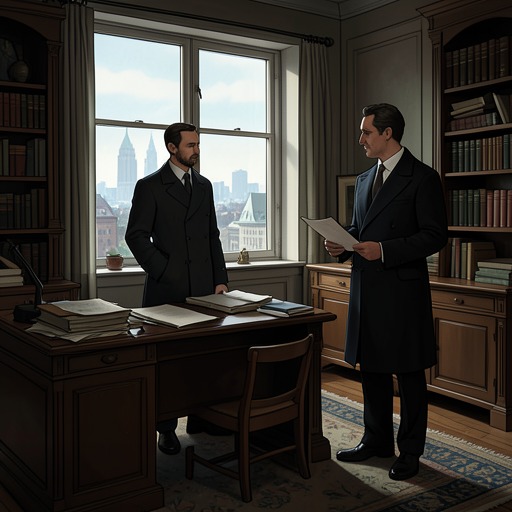
The building strikes him as a curious contrast to the scale of the office. Behind a crooked facade, it winds through small spaces and low doorways. Its age is registered less through grandeur than through the physical difficulties of inhabiting it: warped windows, creaking passages, narrow rooms, and drafts. Christophe runs ahead into its depths, while a vast spider’s web and a loose skirting board make the house seem as though its structure has been left to time and its creatures.
A History of Refuge and Expulsion
The house was founded three centuries earlier by a king named Henry as a refuge for Jews willing to convert to Christianity. Conversion came at a severe material cost: their possessions passed to the Crown. The Crown was then considered responsible for housing and feeding the converts for the remainder of their lives. The building thus embodies a form of royal protection inseparable from the seizure of property that made it necessary.
About fifty years after the house was endowed, Jews were expelled from the realm. The refuge did not become wholly empty, however; in Cromwell’s time, two women still live there. Its history of conversion and expulsion survives not as an abstract record but as an inhabited space, where old arrangements persist after the population they were meant to serve has been driven away.
The Remaining Residents
Cromwell visits the two women, who are known as Katherine Wheteley and Mary Cook. They are watchful and reserved, and when he asks what they do, they answer that they say their prayers. Their guardedness reflects the vulnerability of people whose life stories and continued residence are all that remain to them; Cromwell recognizes that he cannot simply expect them to surrender those stories to him.
He sends them fowl, then brings them wine and twelve Kentish apples wrapped individually in grey linen, a gift from the prior of Christchurch in Canterbury. He tells them about Claricia, a woman recorded as the house’s sole resident in 1353, and wonders where she had lived before Exeter. The women say they know nothing of her. Their cool laughter at Cromwell’s presents and his account of an earlier resident makes the limits of his hospitality plain: gifts may open a conversation, but they do not give him access to their memories or trust.
Cromwell’s Move and the Changing Meaning of Home
Cromwell initially considers moving his clerks and papers to Rolls House while keeping Austin Friars as a home. The plan loses its point as the people around him establish separate households: Rafe is preparing to move to Hackney, Richard is building nearby with his wife Frances, and members of Cromwell’s household are making their own lives. He has done well by his dependants, but their independence leaves him asking who, exactly, would make Austin Friars a home.
At Austin Friars he holds a lease for ninety-nine years and imagines that his great-grandchildren will inherit it. The house’s future is marked in documents and in the arms carved over its doorways, even as his own family arrangements change. Rolls House is different: it draws him nearer the political center and becomes the place where he is installed as Master of the Rolls. He calls his new situation satisfactory, but his first domestic plan has given way to a wider network of properties, leases, and government business.
The move crystallizes Cromwell’s altered sense of belonging. He concludes that his houses will become places of business; his home, when it is not among clerks and files, will be wherever the king is. Christophe remains with him at Rolls House, grateful not to have been left behind, while the rooms that preserve the traces of earlier inhabitants become part of Cromwell’s working life. The building’s layered history gives that transformation a particular weight: a former refuge becomes the residence of a royal servant whose duties increasingly determine where he lives.